


Building a data center is about a lot more than just grabbing some land and plugging in servers. Some companies have managed to slash network latency by up to 30 percent just by choosing the right location. Most people think picking a data center site is mostly a real estate move, but the real story is that where you put your data center can decide how fast your AI works, how much you spend on power, and what kind of disaster might shut you down. The right spot can make or break your competitive edge.
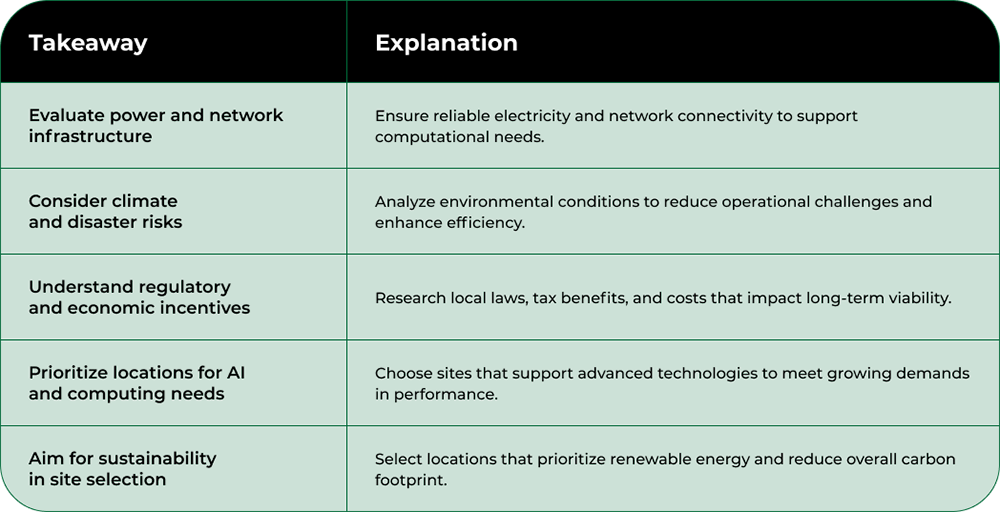
Data center site selection represents a critical strategic process where organizations meticulously evaluate and choose geographic locations and specific sites to construct or establish their computational infrastructure. This complex decision involves analyzing multiple interdependent factors that significantly impact the performance, efficiency, reliability, and long term sustainability of data center operations.
At its fundamental level, data center site selection goes beyond simply finding an available piece of real estate. It involves a comprehensive assessment of technical, environmental, economic, and infrastructure requirements that will support advanced computing needs, particularly for high-performance AI and machine learning applications. Organizations must carefully weigh numerous variables to ensure their chosen location can provide optimal conditions for complex computational workloads.
The strategic importance of data center site selection cannot be overstated. According to Gartner Research, a well-executed site selection process can result in significant cost savings, improved operational efficiency, and enhanced computational performance. These considerations become even more critical as AI and machine learning technologies demand increasingly sophisticated infrastructure.
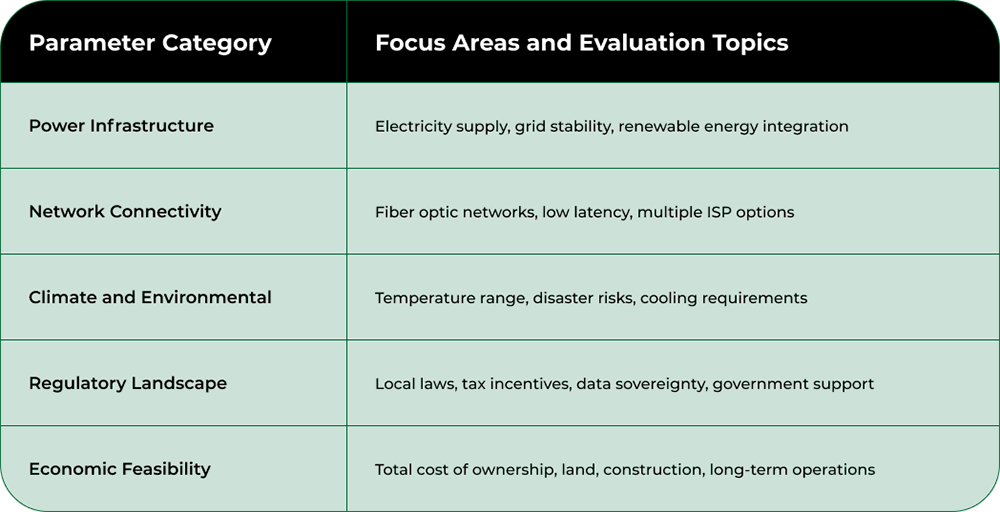
Successful data center site selection requires evaluating multiple critical parameters that collectively determine the suitability of a location. These comprehensive parameters typically include:
By methodically analyzing these parameters, organizations can make informed decisions that optimize their computational infrastructure for maximum performance, efficiency, and strategic advantage.
To help clarify the critical parameters involved in data center site selection, the following table organizes key evaluation categories alongside their detailed focus areas as presented in the article.
The geographic location of a data center is far more than a simple real estate decision. It represents a strategic asset that directly influences an organization’s computational performance, operational efficiency, financial sustainability, and competitive positioning in an increasingly digital global marketplace.
Data center location plays a crucial role in determining network performance and computational responsiveness. Proximity to key network infrastructure and end-users dramatically reduces data transmission latency, which is particularly critical for AI and machine learning applications requiring instantaneous data processing. According to Forrester Research, organizations can reduce network latency by up to 30% through strategic geographical positioning.
Beyond technical performance, data center location significantly impacts an organization’s economic landscape. Different geographic regions offer unique economic incentives that can substantially reduce operational expenses. These location-based advantages include:
Geographic selection serves as a critical risk mitigation strategy. Organizations must carefully evaluate potential environmental and infrastructure risks associated with different locations. This includes assessing factors like:
By understanding these location-specific risks, businesses can design more robust and resilient computational infrastructure that maintains continuous operational capabilities even under challenging circumstances. Strategic data center location becomes a fundamental element of comprehensive risk management and business continuity planning.
Data center site selection represents a multifaceted decision-making process involving complex technical, economic, and strategic considerations. Organizations must meticulously evaluate numerous interconnected factors to ensure optimal computational infrastructure deployment that meets current and future technological requirements.
Technical infrastructure forms the foundational cornerstone of data center site selection. Critical technical parameters demand comprehensive evaluation to guarantee robust computational capabilities. IEEE Computer Society emphasizes the importance of assessing network connectivity, power reliability, and computational environment stability as primary technical considerations.
Key Technical Evaluation Parameters:
Beyond pure technical metrics, geopolitical and economic landscapes play pivotal roles in data center site determination. Organizations must strategically analyze regional economic policies, potential tax incentives, labor market dynamics, and long-term financial sustainability. These factors directly influence operational expenses and potential return on infrastructure investment.
Strategic Economic Factors:
Modern data center site selection increasingly prioritizes environmental sustainability and climate resilience. Organizations must evaluate potential locations through comprehensive ecological lenses, considering renewable energy potential, natural disaster risks, and long-term climate change implications. According to World Economic Forum, sustainable site selection can reduce carbon footprint by up to 40% and generate significant operational efficiencies.
Environmental Evaluation Criteria:
By holistically assessing these multidimensional factors, organizations can make informed decisions that create resilient, efficient, and forward-looking computational infrastructure aligned with strategic business objectives.
Data centers have evolved from simple computational storage facilities to sophisticated technological ecosystems that provide critical infrastructure for advanced computing, particularly in artificial intelligence and machine learning domains. These complex environments are engineered to deliver the immense computational power, storage capacity, and network connectivity required by modern technological applications.
Advanced data centers function as high-performance computing environments designed to support complex computational workloads. Specialized hardware configurations enable these facilities to process massive datasets and execute intricate algorithmic processes with unprecedented speed and efficiency. Gartner Research indicates that modern data centers can provide computational capabilities that dramatically accelerate machine learning model training and inference processes.
Key Computational Support Features:
Modern data centers are specifically architected to meet the unique demands of artificial intelligence and machine learning applications. These environments provide specialized infrastructure that goes beyond traditional computational requirements. By exploring our HPC guide for AI and data centers, organizations can understand the intricate technological ecosystems that enable advanced computational capabilities.
AI and machine learning workloads require extraordinary computational resources that traditional computing infrastructures cannot support. Data centers address these needs through:
Beyond raw computational power, data centers ensure continuous, reliable operation critical for advanced computing environments. Redundant systems, sophisticated monitoring technologies, and comprehensive backup mechanisms guarantee minimal downtime and maximum computational availability. These facilities implement multiple layers of resilience to protect against potential infrastructure failures, ensuring that complex AI and machine learning processes can run uninterrupted.
Successful data center locations represent strategic investments that demonstrate how thoughtful site selection can transform computational infrastructure into powerful competitive advantages. These real-world examples illustrate the complex interplay of technical, economic, and environmental factors that drive optimal data center performance.
Northern European regions have emerged as prime data center locations, leveraging unique geographic and infrastructural advantages. Countries like Iceland and Norway offer exceptional conditions that make them attractive for advanced computational infrastructure. MIT Technology Review highlights how these regions provide critical benefits:
Key Competitive Advantages:
The Southwestern United States has developed into a significant data center ecosystem, particularly in states like Arizona and Nevada. These regions offer compelling combinations of economic incentives, infrastructure stability, and favorable environmental conditions.
IMAGE:descriptive_key_1] By [exploring our HPC guide for AI infrastructure, organizations can deeper understand these strategic location dynamics.
Strategic Location Benefits:
Certain Asian regions have rapidly developed sophisticated data center ecosystems by implementing comprehensive national technological strategies. Singapore and parts of China have transformed themselves into global computational infrastructure hubs through deliberate, strategic investments. According to World Economic Forum, these locations demonstrate how targeted national policies can create compelling computational environments.
Critical Success Factors:
These case studies underscore that successful data center locations are not accidents but the result of meticulous planning, strategic thinking, and holistic infrastructure development.
This table compares the competitive advantages and benefits offered by different successful data center locations highlighted in the article.

Choosing the right data center location is key to unlocking the full potential of your AI and HPC initiatives. If you are struggling with evaluating power infrastructure, network connectivity, compliance, or sourcing the right AI-ready hardware for a new site, you are not alone. Many organizations find it difficult to match their ambitious AI goals with actual infrastructure availability and reliable procurement. This can slow down innovation and lead to missed opportunities. Take control and accelerate your success with a partner that understands the complexities of advanced computational needs highlighted in the article.
Explore the specialized solutions at https://nodestream.blockwaresolutions.com to access verified GPU servers, scalable HPC equipment, and support services designed for complex deployments. Make your next move a strategic advantage by viewing real-time inventory and leveraging our expertise for your AI project. Do not wait—visit us now to bridge the gap between understanding and action.
When selecting a data center site, consider key factors such as power infrastructure, network connectivity, climate conditions, regulatory landscape, and economic feasibility to ensure optimal operational efficiency and sustainability.
The location of a data center significantly impacts AI and machine learning performance by reducing network latency and improving computational responsiveness, leading to more efficient data processing and better overall outcomes.
Choosing an optimal data center location can lead to economic advantages such as tax incentives, lower energy costs, access to a skilled labor market, and overall reduced operational expenses due to favorable local conditions.
Environmental sustainability is critical in data center site selection. Factors such as renewable energy potential, natural disaster risks, and climate resilience help organizations minimize their carbon footprint and enhance operational efficiencies.
AI computing is quietly redrawing the boundaries of crypto, finance, and high-performance computing. Brace yourself. By…

Artificial intelligence is turbocharging the world of finance as never before, shaking up how both…

Digital transformation is about to completely reshape how we use crypto and artificial intelligence in…


