


Every business relies on technology, yet most underestimate how fragile their digital infrastructure can be. Surprising as it may sound, over 40 percent of businesses never reopen after a major data loss event. Disaster recovery plans are talked about a lot, but most companies do not realize the secret weapon is not just having a plan, but testing and updating it constantly. What actually saves an organization is the groundwork laid before chaos ever strikes.
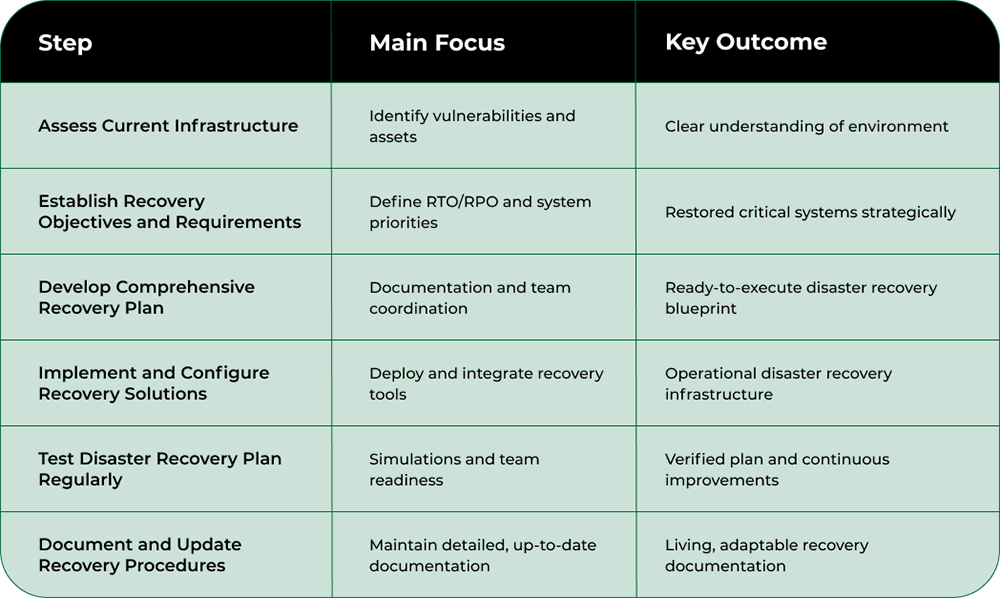
This table provides an at-a-glance step overview of the six main phases in streamlining a data center disaster recovery strategy, with their primary focus and a brief outcome.
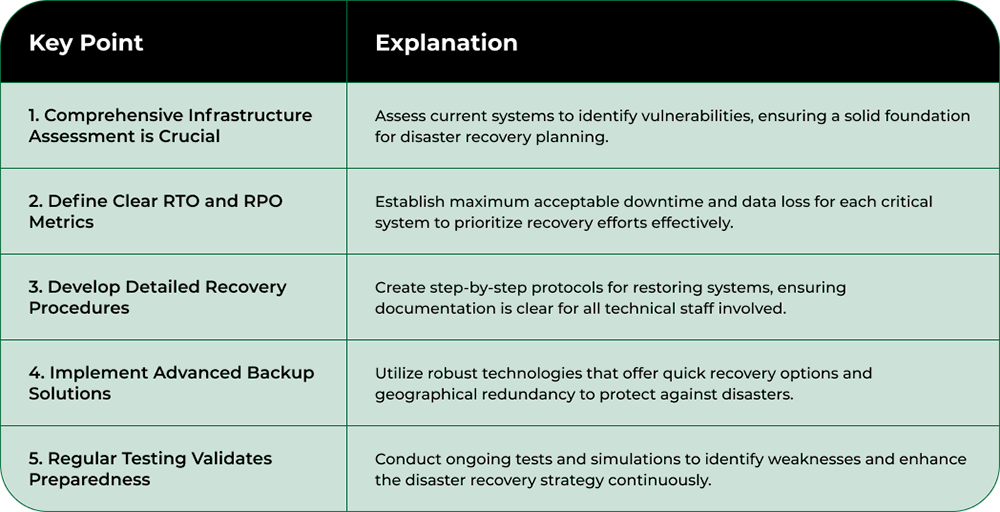
A robust data center disaster recovery strategy begins with a comprehensive assessment of your existing technological infrastructure. This critical first step helps you understand your current capabilities, identify potential vulnerabilities, and create a strategic roadmap for resilience.
Start by conducting a detailed inventory of your entire hardware and software ecosystem. This means mapping out every server, network device, storage system, and critical application. Document their current configurations, interdependencies, and performance metrics. Pay special attention to mission-critical systems that, if compromised, could significantly disrupt your organization’s operations.
Next, perform a thorough risk assessment that examines potential disaster scenarios specific to your infrastructure. According to the Indiana Office of Technology, this involves identifying potential failure points, understanding potential impact zones, and evaluating the likelihood of different disaster events. Consider environmental risks like power failures, natural disasters, cyber attacks, and hardware malfunctions. Create a comprehensive risk matrix that ranks these potential disruptions by their probability and potential organizational impact.
Evaluate your current backup and redundancy systems with a critical eye. Determine the resilience of your data storage solutions, network configurations, and recovery mechanisms. Ask yourself key questions: How quickly can you restore systems after a failure? What are your current recovery time objectives (RTO) and recovery point objectives (RPO)? Are your backup systems geographically diverse and isolated from potential simultaneous failure scenarios?
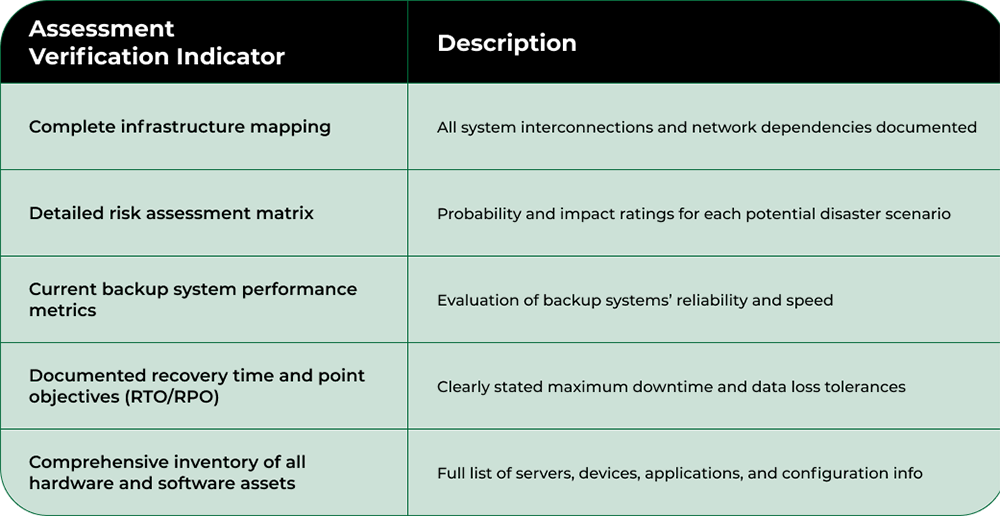
Verify your assessment by checking these critical indicators:
The following checklist table summarizes the key verification indicators to confirm a thorough assessment of your data center infrastructure is complete.
Remember, a successful infrastructure assessment is not a one-time event but an ongoing process. Regular reassessments will help you maintain an adaptive and resilient disaster recovery strategy that evolves with your technological landscape.
After thoroughly assessing your infrastructure, the next critical phase in data center disaster recovery is establishing clear recovery objectives and comprehensive requirements. This step transforms your initial infrastructure assessment into a strategic roadmap for resilience and rapid system restoration.
Begin by defining your Recovery Time Objective (RTO) and Recovery Point Objective (RPO) for each critical system. RTO represents the maximum acceptable downtime, while RPO determines the maximum acceptable data loss window. These metrics vary significantly across different organizational functions.
Financial transaction systems might require near-zero data loss and minimal downtime, whereas less critical systems could tolerate longer recovery periods.
According to the University of Maryland Global Campus, developing a comprehensive disaster recovery plan involves identifying and protecting critical information systems and confidential data. This means conducting a detailed analysis of each system’s criticality, potential impact of failure, and specific recovery requirements.
Classify your systems into prioritized tiers based on their organizational importance. Create a detailed restoration priority list that outlines which systems must be restored first during a disaster scenario. This classification helps allocate resources efficiently and ensures that the most crucial functions are recovered quickly.

Consider factors like revenue impact, regulatory compliance, customer service continuity, and interdependencies between different technological systems.
Document your recovery requirements with extraordinary precision. This documentation should include detailed technical specifications, current system configurations, network dependencies, and specific recovery procedures for each system tier. Develop clear, step-by-step protocols that any qualified technical professional could follow during a high-stress recovery scenario.
Verify your recovery objectives by checking these critical indicators:
Remember that establishing recovery objectives is not a static process. Regular review and updates are essential to maintain alignment with evolving technological landscapes and organizational needs.
With your infrastructure assessment and recovery objectives established, the next crucial phase is developing a comprehensive disaster recovery plan that transforms strategic objectives into actionable protocols. This blueprint will serve as your organization’s lifeline during potential technological disruptions.
Start by creating a detailed communication matrix that outlines precise responsibilities and contact protocols for every team member involved in the recovery process. This matrix should include primary and backup contacts, their specific roles during a disaster scenario, and multiple communication channels to ensure redundancy. Each team member must understand their exact responsibilities, reporting structures, and escalation procedures.
According to Yale University’s Cybersecurity department, a robust disaster recovery plan must address step-by-step procedures for restoring IT systems, coordinate personnel efforts, and provide clear guidelines for communication and system restoration. Design your plan to be both comprehensive and flexible, anticipating various potential disaster scenarios while maintaining adaptability.
Document detailed recovery procedures for each critical system identified in previous assessment stages. These procedures should include precise technical steps for system restoration, data recovery protocols, and specific configuration requirements. Include detailed network diagrams, system interconnection maps, and explicit instructions that can be followed by any qualified technical professional, even under high-stress conditions.
Incorporate redundancy and failover mechanisms into your plan. This means developing alternative infrastructure strategies, identifying backup data centers or cloud resources, and establishing clear protocols for seamlessly transitioning between primary and secondary systems. Your plan should minimize potential single points of failure and provide multiple recovery pathways.
Verify your recovery plan’s effectiveness through these critical indicators:
Remember that a disaster recovery plan is a living document. Regular review, updates, and simulation exercises are essential to maintaining its relevance and effectiveness in an ever-changing technological landscape.
With a comprehensive disaster recovery plan in place, the next critical stage is implementing and configuring the actual recovery solutions that will transform your strategic blueprint into operational reality. This step bridges theoretical planning with practical technological implementation.
Begin by selecting robust backup and replication technologies that align precisely with your previously established recovery time objectives (RTO) and recovery point objectives (RPO). Focus on solutions that offer near-instantaneous failover capabilities and granular recovery options. Implement a multi-tiered backup strategy that includes local snapshots, offsite replication, and cloud-based disaster recovery platforms to ensure comprehensive data protection across different scenarios.
According to research exploring automated disaster recovery systems, innovative approaches are emerging that can detect and respond to infrastructure failures within seconds. Leverage these advanced technologies to create intelligent, self-healing recovery mechanisms. Configure automated monitoring systems that can detect potential failures in real time, trigger predefined recovery protocols, and minimize manual intervention during critical restoration processes.
Carefully design your recovery infrastructure with redundancy and geographical diversity as core principles. This means distributing critical systems across multiple data centers or cloud regions, ensuring that a localized disaster cannot compromise your entire technological ecosystem. Implement network configurations that allow seamless traffic routing and system failover, creating resilient pathways that can dynamically adapt to infrastructure challenges.
Ensure your recovery solutions integrate smoothly with existing systems by conducting thorough compatibility testing. Validate that backup and restoration tools can interact effectively with your current hardware, software, and networking infrastructure. Pay special attention to data migration processes, ensuring that recovery mechanisms can accurately and completely restore system states without data corruption or loss.
Verify your recovery solution implementation through these critical indicators:
Remember that implementing recovery solutions is an iterative process. Continuous testing, refinement, and adaptation are essential to maintaining a robust and responsive disaster recovery strategy.
Regular testing transforms your disaster recovery plan from a theoretical document into a reliable, actionable strategy. This critical step validates the effectiveness of your meticulously developed recovery protocols and exposes potential vulnerabilities before an actual disaster occurs.
Implement a comprehensive testing framework that includes multiple scenarios and exercise types. Begin with tabletop simulations where key team members walk through recovery procedures without actually activating systems. These discussions reveal communication gaps, procedural inconsistencies, and potential coordination challenges. Progress to more advanced testing methods like partial system failovers and full-scale disaster recovery simulations that comprehensively validate your entire recovery infrastructure.
According to the National Institute of Standards and Technology, disaster recovery plan testing is critical to ensure operational effectiveness and identify preparedness gaps. Design your testing approach to be systematic and progressively complex. Start with low-risk scenarios and gradually increase the complexity and scope of your recovery exercises.
Document every test meticulously, tracking performance metrics, response times, system recovery capabilities, and team coordination. Create detailed after-action reports that capture not just what happened during the test, but specific recommendations for improving your disaster recovery strategy. Pay special attention to identifying bottlenecks, communication delays, and technical limitations that emerge during testing.
Ensure your testing covers a comprehensive range of potential disaster scenarios. This means simulating different types of infrastructure failures, including network outages, hardware malfunctions, cyber attacks, and environmental disruptions. Your goal is to build a resilient recovery strategy that can adapt to unpredictable and evolving technological challenges.
Verify your testing effectiveness through these critical indicators:
Remember that testing is not a one-time event but an ongoing process. Schedule regular testing intervals, maintain flexibility in your approach, and continuously evolve your disaster recovery strategy based on emerging technologies and organizational changes.

Documenting and updating recovery procedures transforms your disaster recovery strategy from a theoretical framework into a living, adaptable system that can evolve with your technological infrastructure. This critical step ensures that your organization maintains a clear, comprehensive roadmap for navigating potential technological disruptions.
Create exhaustive documentation that goes beyond simple procedural checklists. Develop a comprehensive recovery manual that includes detailed system configurations, network diagrams, critical contact information, and step-by-step restoration protocols for each infrastructure component. Ensure that the documentation is written with such clarity that any qualified technical professional could execute the recovery procedures without prior intimate knowledge of your specific systems.
According to the University of Michigan, disaster recovery plans should be reviewed and updated annually or whenever significant changes occur in IT infrastructure. Establish a systematic review process that mandates regular documentation updates. This means conducting thorough assessments whenever new technologies are implemented, organizational structures change, or critical system configurations are modified.
Implement a version control system for your recovery documentation to track changes and maintain historical context. Use digital platforms that allow collaborative editing, provide clear audit trails, and enable secure access for authorized personnel. Ensure that multiple team members can contribute to and review documentation, creating a collective knowledge base that transcends individual expertise.
Design your documentation to be both comprehensive and accessible. Include not just technical procedures, but also decision-making frameworks, escalation protocols, and communication strategies. Create visual aids like flowcharts and network diagrams that can quickly orient team members during high-stress recovery scenarios. Consider developing both detailed technical guides and simplified quick-reference materials.
Verify your documentation and update process through these critical indicators:
Remember that documentation is not a static artifact but a dynamic tool. Continuous refinement, collaborative input, and a commitment to clarity will transform your recovery procedures into a robust, adaptable strategic asset.
Are you struggling to achieve robust backup, redundancy, and rapid recovery in your data center disaster recovery strategy? Many organizations find it challenging to bridge the gap between their disaster recovery goals and the real-world limitations of their current infrastructure. You know the importance of reliable, scalable systems for RTO and RPO compliance, especially when rapid restoration and seamless failover are non-negotiable for critical AI and high-performance workloads.
Why wait until the next incident to discover a gap in your recovery plan? Access a marketplace built for secure, quick, and transparent transactions. At NodeStream by Blockware Solutions, you can find and deploy HPC servers, GPU clusters, and AI-ready infrastructure with verified listings, global logistics support, and real-time inventory. Feel confident scaling your disaster recovery capabilities instantly and keeping every part of your strategy resilient.
Remove bottlenecks now. Explore available solutions at https://nodestream.blockwaresolutions.com and see how quickly your recovery plan can move from the drawing board to actionable, supported infrastructure. Don’t risk downtime or lost data—start optimizing your data center’s resilience today.
A comprehensive assessment of your existing technological infrastructure is the first step. This includes mapping out hardware, software, and identifying potential vulnerabilities.
Consider the maximum acceptable downtime and data loss for each critical system, as these objectives can vary significantly across different organizational functions.
It’s essential to conduct regular testing at scheduled intervals and after significant infrastructure changes to ensure the effectiveness of your recovery plan and identify any potential vulnerabilities.
A comprehensive recovery plan should include a communication matrix, detailed recovery procedures, redundancy strategies, and clearly defined roles and responsibilities for the recovery team.

AI computing is quietly redrawing the boundaries of crypto, finance, and high-performance computing. Brace yourself. By…

Artificial intelligence is turbocharging the world of finance as never before, shaking up how both…

Digital transformation is about to completely reshape how we use crypto and artificial intelligence in…


