Choosing between in house and cloud AI solutions can shape everything from data security to how fast you can launch new projects. One fact stands out. Cloud services now handle more than 90 percent of all AI workloads for major tech companies. That sounds unstoppable. But the surprising part is that more organizations are bringing critical projects back in house or adopting hybrid setups to balance control with convenience. This shift is about to change how companies think about their entire AI strategy.
| Takeaway | Explanation |
|---|---|
| In house solutions offer complete control | These systems allow organizations to customize and manage their AI infrastructure entirely on-site, ensuring security and performance reliability. |
| Cloud solutions provide dynamic scalability | Organizations can quickly adjust computational resources in the cloud to meet changing demands without investing in physical hardware. |
| Cost dynamics differ significantly | In house solutions require high upfront investments, while cloud services shift costs to a pay-as-you-go model, reducing initial financial barriers. |
| Security considerations vary between approaches | In house solutions enhance data control, whereas cloud services necessitate careful evaluation of data privacy and compliance risks. |
| Hybrid models are the future | Combining in house and cloud strategies can optimize performance and cost efficiency, integrating the strengths of both approaches. |
In the rapidly evolving landscape of AI infrastructure, understanding the fundamental differences between in house and cloud solutions becomes critical for organizations seeking optimal computational strategies. Research from ResearchGate highlights the nuanced approaches organizations can take when deploying AI technologies.
In house solutions represent computing infrastructure and AI resources developed, deployed, and managed entirely within an organization’s physical premises. These systems provide maximum control, allowing companies to customize hardware configurations, maintain strict security protocols, and design computing environments precisely tailored to their specific computational requirements.
Key characteristics of in house solutions include:
Cloud solutions represent a fundamentally different approach to AI computational resources. Instead of maintaining physical infrastructure, organizations leverage remote datacenters accessible through internet connections. These platforms offer unprecedented scalability, allowing businesses to dynamically adjust computational power based on immediate requirements.
Primary advantages of cloud AI infrastructure include:
By understanding these two distinct computational paradigms, organizations can make strategic decisions about their AI infrastructure, balancing factors like control, cost, scalability, and performance to achieve optimal technological outcomes.
The following table compares key features and differences between in house and cloud AI solutions, helping readers quickly assess which approach may align better with their needs.
| Feature | In House Solutions | Cloud Solutions |
|---|---|---|
| Control & Customization | Full control, highly customizable | Limited direct control, standardized offerings |
| Hardware Ownership | Organization owned and managed | Provided and managed by cloud provider |
| Scalability | Manual and often slow to scale | Instantly scalable, flexible |
| Upfront Investment | High capital expenditure required | Low upfront investment, pay-as-you-go |
| Maintenance | Responsibility of internal IT team | Handled by provider |
| Data Sovereignty | Maximum, remains on-premises | Dependent on cloud provider’s policies |
| Typical Use Cases | Sensitive data, strict compliance needs | Rapid prototyping, variable workloads |
Navigating the complex landscape of AI infrastructure requires a deep understanding of the fundamental differences between in house and cloud services. According to research from the National Institutes of Health, these approaches represent distinct computational paradigms with unique advantages and challenges.
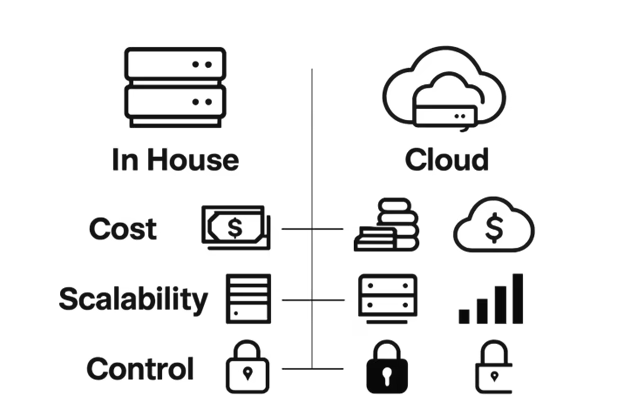
The financial implications of in house versus cloud services create a significant divergence in organizational strategy. In house solutions demand substantial upfront capital expenditure, requiring organizations to purchase physical hardware, invest in data center infrastructure, and maintain ongoing operational costs. Companies must budget for server hardware, cooling systems, network equipment, and dedicated IT personnel.
Cloud services, by contrast, operate on a fundamentally different economic model:
Scalability represents another critical differentiator between in house and cloud services. In house infrastructure requires manual expansion, involving purchasing new hardware, configuring systems, and integrating additional computational resources. This process is time consuming and often requires significant technical expertise.
Cloud services offer dynamic scalability, enabling organizations to:
By understanding these nuanced differences, organizations can make strategic decisions that align technological capabilities with business objectives, balancing control, cost, and computational efficiency.
According to cloud computing research from Coursera, organizations must carefully evaluate the complex trade offs between in house and cloud computational strategies. Understanding these nuanced approaches requires a comprehensive examination of their respective strengths and limitations.
In house solutions provide unparalleled control and performance predictability. Organizations can design computational environments precisely tailored to their specific requirements, ensuring maximum hardware optimization and minimal external dependencies. This approach enables direct management of security protocols, hardware configurations, and computational resources.
Key advantages of in house infrastructure include:
Cloud services introduce complex security and compliance considerations. While offering significant computational flexibility, cloud platforms require organizations to carefully evaluate data protection mechanisms, network security, and regulatory compliance. Sensitive industries like healthcare and finance must conduct thorough risk assessments before migrating critical computational workloads.
Potential cloud service limitations encompass:
By comprehensively understanding these multifaceted approaches, organizations can develop strategic computational infrastructures that balance technological capabilities, financial considerations, and operational requirements.
This table outlines benefits and drawbacks unique to in house and cloud AI infrastructure approaches, offering a side-by-side view to clarify trade offs faced by organizations.
| Approach | Benefits | Drawbacks |
|---|---|---|
| In House | Customizable, maximum control, enhanced security | High upfront cost, slower to scale, ongoing maintenance |
| Cloud | Flexible scaling, low entry cost, global access | Less direct control, potential data privacy concerns |
According to research from DeepAI, real-world AI and machine learning deployments demonstrate the critical importance of selecting appropriate computational infrastructure. These applications span diverse industries, each presenting unique computational requirements and challenges.
In medical research and diagnostics, computational infrastructure directly impacts research capabilities. Machine learning models analyzing medical imaging require substantial computational power and stringent data privacy protections. In house solutions become particularly attractive for hospitals and research institutions handling sensitive patient data, enabling direct control over complex medical datasets.
Key healthcare AI application domains include:

Financial institutions leverage AI for sophisticated risk assessment, fraud detection, and algorithmic trading. These applications demand high-performance computational environments with near-instantaneous processing capabilities. While cloud services offer flexibility, many financial organizations prefer in house solutions to maintain absolute control over sensitive transactional data.
Primary AI applications in financial services encompass:
For organizations seeking deeper insights into computational strategies, our guide on AI computing infrastructure provides comprehensive analysis of emerging technological trends.
Emerging research from distributed computing frameworks suggests significant transformations are underway in computational infrastructure strategies. Organizations are increasingly exploring hybrid models that combine the strengths of in house and cloud computational approaches.
Hybrid infrastructure models represent the next evolutionary stage of AI computational strategies. These approaches integrate the control and security of in house solutions with the scalability and flexibility of cloud platforms. By creating dynamic, adaptable computational environments, organizations can optimize performance, reduce costs, and maintain robust data governance.
Key characteristics of emerging hybrid architectures include:
Future computational strategies are increasingly emphasizing distributed computing models. These approaches decentralize computational processing, leveraging edge devices and localized computational resources to complement traditional cloud and in house infrastructure. This trend enables faster processing, reduced latency, and more efficient data handling across complex AI workloads.
Emergent distributed computing trends encompass:
For organizations seeking comprehensive insights into technological evolution, our guide on digital transformation strategies provides strategic perspectives on emerging computational paradigms.
Are you struggling to choose between the control of in house solutions and the agility of cloud platforms for your AI initiatives? Many organizations feel caught between costly hardware investments, urgent scalability needs, and the growing demands of high-performance AI workloads. The stakes are high. Whether you need complete data sovereignty, faster scaling, or more efficient use of your machine learning resources, making the right choice now can drastically impact your success. Streamline your infrastructure journey with solutions that perfectly match your goals.
Visit Nodestream by Blockware Solutions and experience a smarter way to buy, sell, or scale your AI-ready servers and HPC hardware. Discover verified inventory for bulk ordering, custom configurations, and global logistics support all delivered with full transparency. Take advantage of our comprehensive AI computing infrastructure guide to see how you can evolve your strategy today. Do not wait for your competitors to upgrade their tech stack first. Invest with confidence and get the edge your team deserves.
In house solutions provide complete control over hardware and security, along with predictable performance. Cloud solutions, on the other hand, offer scalability, reduced upfront investment, and simplified maintenance.
In house solutions allow organizations to customize infrastructure, maintain data sovereignty, and ensure enhanced security control over sensitive information, making them suitable for industries with stringent compliance requirements.
Cloud solutions offer dynamic scalability, enabling organizations to easily adjust computational resources based on current demands without the need for significant physical hardware changes or manual configuration.
Industries such as healthcare and finance benefit greatly from in house solutions due to their need for high-performance computing, stringent data privacy requirements, and the desire for direct control over sensitive data.