


Choosing the right home for your company’s servers sounds simple until you see the options on the table. Businesses now face a marketplace where cloud spending has jumped by over 30 percent in recent years, yet traditional solutions like colocation and managed hosting are still thriving. It might seem like everyone should move to the cloud, but sometimes keeping your own hardware or hiring hands-on experts actually makes more sense—and could even save you money in the long run.
Infrastructure hosting represents a critical decision for organizations seeking robust computational resources. Understanding the nuanced differences between colocation, managed hosting, and cloud services enables strategic technology deployment that aligns with specific business requirements.
At its core, infrastructure hosting provides organizations a mechanism to house, manage, and operate computational hardware and software systems. Each hosting model offers unique advantages and considerations that impact performance, cost, control, and scalability.
Colocation Services Colocation represents a model where organizations physically own their server hardware but lease rack space, power, cooling, and network connectivity within a third-party data center. According to NIST, this approach allows companies to leverage professional infrastructure while maintaining direct hardware ownership and control.
Key characteristics of colocation include:
Managed hosting extends beyond physical infrastructure placement, incorporating comprehensive technical management and support services. In this model, the service provider not only provides data center space but also handles server maintenance, software updates, security monitoring, and technical troubleshooting.
Unlike pure colocation, managed hosting offers a more hands-off approach for organizations wanting robust infrastructure without extensive internal technical resources. Clients benefit from expert management while retaining significant customization options for their computational environments.
Cloud services represent a dynamic, flexible infrastructure model characterized by on-demand resource provisioning and consumption-based pricing. As EDUCAUSE Review explains, cloud computing encompasses three primary service models:
The primary distinction between cloud services and traditional hosting models lies in their inherent flexibility, scalability, and abstraction of physical infrastructure management. Organizations can rapidly scale resources, optimize costs, and focus on core business objectives rather than infrastructure maintenance.
Understanding the fundamental differences between colocation, managed hosting, and cloud services is crucial for organizations seeking optimal infrastructure solutions. While these models share the common goal of providing computational resources, their approaches to hardware ownership, management, scalability, and cost structure vary significantly.
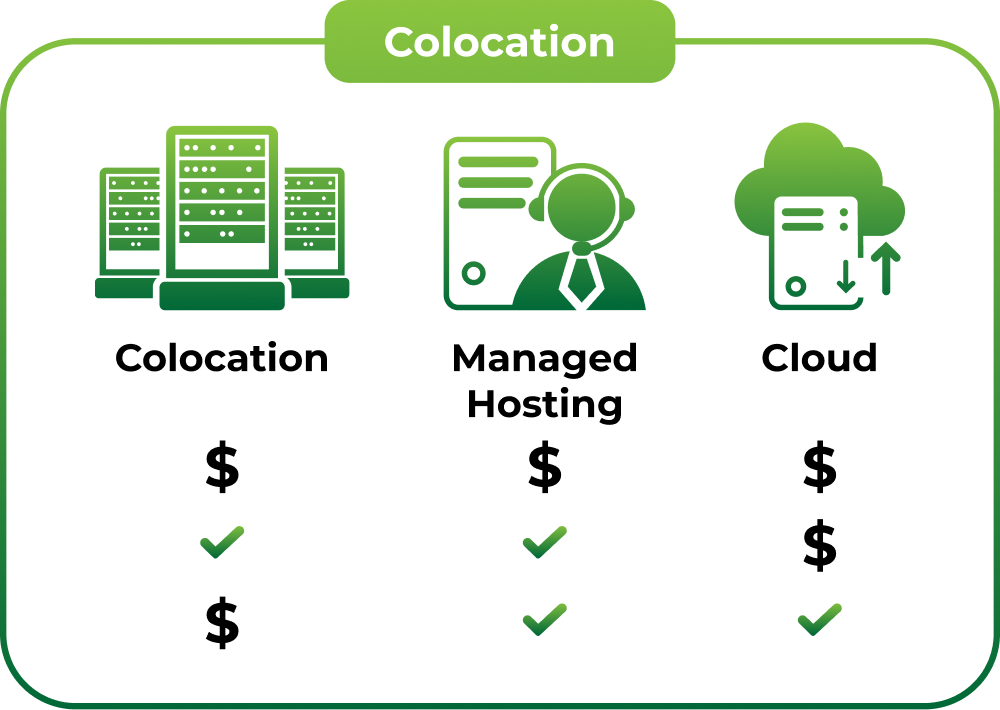
The primary differentiation among these hosting models lies in hardware ownership and control mechanisms. According to CompTIA, each model presents a unique approach to infrastructure management:

Each hosting model presents distinct financial considerations that impact organizational budgeting and resource allocation. Colocation requires significant upfront capital expenditure for hardware procurement, while managed hosting and cloud services offer more predictable operational expenses.
The ability to adapt computational resources to changing business needs represents a critical differentiator among hosting models. Cloud services excel in providing unprecedented flexibility, enabling organizations to rapidly provision or decommission resources without physical infrastructure constraints.
Organizations must carefully evaluate their specific computational requirements, budget constraints, and long-term strategic objectives when selecting an infrastructure hosting model.
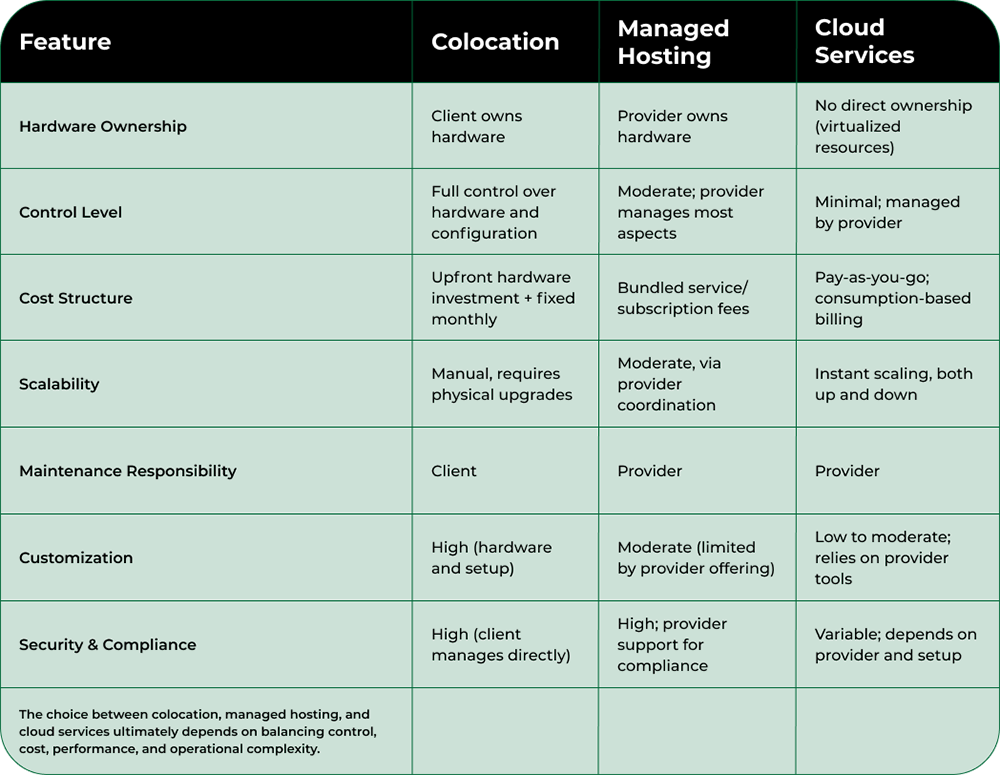
The table below compares the core characteristics of colocation, managed hosting, and cloud services to help clarify their unique strengths and considerations.
Choosing the right infrastructure hosting solution requires a nuanced understanding of the advantages and potential limitations inherent in colocation, managed hosting, and cloud services. Organizations must carefully evaluate these factors to align technological infrastructure with strategic business objectives.
Colocation offers organizations unprecedented hardware control and customization potential. According to World Bank Research, this model provides distinct advantages and challenges:
Managed hosting bridges the gap between direct hardware control and outsourced infrastructure management. This model provides organizations with professional technical support while reducing operational complexity.
Cloud services represent the most dynamic infrastructure model, offering unprecedented resource allocation and cost optimization capabilities. The pay-as-you-go model enables organizations to align computational resources precisely with operational demands.
Ultimately, the optimal hosting solution depends on an organization’s specific technological requirements, budgetary constraints, scalability needs, and long-term strategic goals. Careful evaluation of these factors ensures selecting an infrastructure model that maximizes operational efficiency and technological capabilities.
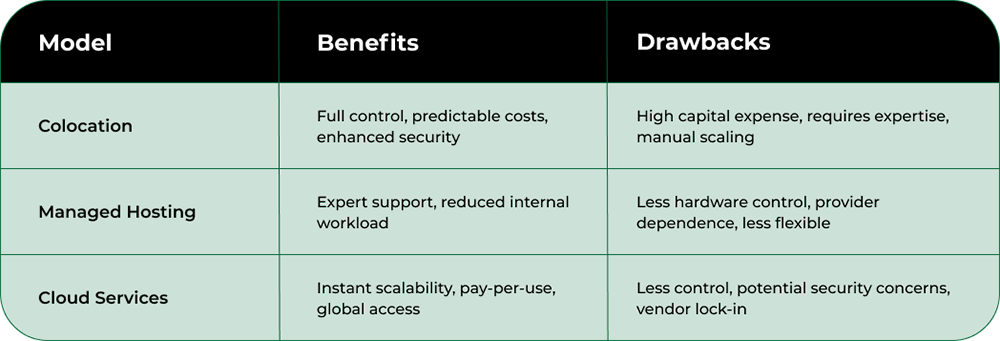
Below is a summary highlighting prominent benefits and drawbacks of each hosting solution, enabling quick comparison for decision-making.
High-performance computing (HPC) and artificial intelligence workloads demand sophisticated infrastructure solutions that provide exceptional computational power, scalability, and reliability. Explore the fundamentals of HPC infrastructure to understand how different hosting models address complex computational requirements.
Artificial intelligence and machine learning applications necessitate robust infrastructure capable of handling massive parallel processing, extensive memory bandwidth, and rapid data transfer. According to EDUCAUSE Research, each hosting model presents unique capabilities for supporting AI computational demands:
High-performance computing environments require infrastructure solutions that can efficiently manage complex computational tasks, large-scale data processing, and scientific research workloads. Different hosting models offer varying approaches to supporting HPC infrastructure needs:
Cloud services have revolutionized AI and HPC infrastructure by providing unprecedented flexibility and resource allocation capabilities. The dynamic nature of cloud platforms enables organizations to scale computational resources precisely according to project requirements:
Organizations must carefully evaluate their specific AI and HPC requirements, considering factors such as data sensitivity, computational intensity, budget constraints, and long-term scalability when selecting an infrastructure hosting solution. The optimal approach often involves a hybrid strategy that leverages the strengths of multiple hosting models to create a comprehensive computational ecosystem.
Selecting the appropriate infrastructure hosting solution requires a strategic approach that aligns technological capabilities with organizational objectives. Learn about enterprise infrastructure strategies to make informed decisions that optimize computational performance and cost-effectiveness.
Accurate evaluation of computational needs forms the foundation of infrastructure selection. According to Academic Research, organizations must comprehensively analyze multiple critical factors:
Beyond technical specifications, financial implications play a crucial role in infrastructure decision-making. Organizations must conduct a thorough cost-benefit analysis that extends beyond immediate expenses and considers long-term operational efficiency:
Successful infrastructure selection involves creating a holistic strategy that integrates technological capabilities with organizational goals. This approach requires balancing technical requirements, financial constraints, and future growth potential:
The optimal infrastructure solution is not a one-size-fits-all approach but a carefully crafted strategy that reflects an organization’s unique technological ecosystem. Continuous evaluation and willingness to adapt infrastructure models ensures sustained computational effectiveness and competitive technological capabilities.
Exploring the difference between colocation, managed hosting, and cloud services can feel overwhelming, especially if you need confident control, proven scalability, and cost-effective solutions. Maybe you are wrestling with infrastructure ownership, budget uncertainty, or the need to rapidly expand AI workloads. What you want is transparency, flexibility, and a partner who understands the scale and urgency described in this article.
Stop letting indecision or hardware limitations slow your growth. Move from research to results by leveraging the high-performance computing marketplace built specifically for AI and HPC organizations. Access verified listings of GPU servers and AI-ready systems, request custom solutions that fit your hybrid needs, and streamline your procurement with rapid, enterprise service support. Visit https://nodestream.blockwaresolutions.com now and make your next infrastructure decision a strategic win.
Colocation is a hosting model where organizations own their server hardware but lease rack space, power, cooling, and network connectivity within a third-party data center, allowing for direct control and management of their hardware.
Managed hosting differs from colocation as the service provider owns and manages the hardware, while the client leases fully configured server infrastructure. The provider handles maintenance and support, making it more suitable for organizations with limited technical resources.
Cloud services offer significant advantages like instant scalability, flexible pricing based on consumption, and easier resource management without the need for direct hardware ownership, providing organizations with rapid resource allocation to meet dynamic demands.
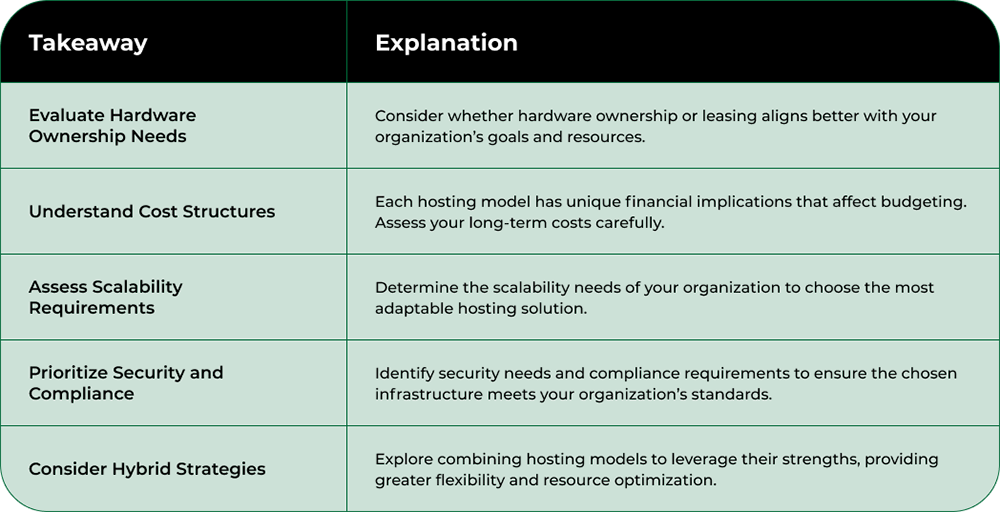
Organizations should consider key factors such as hardware ownership and control, cost structure, scalability, operational complexity, and specific business requirements when selecting the most suitable infrastructure hosting solution.
AI computing is quietly redrawing the boundaries of crypto, finance, and high-performance computing. Brace yourself. By…

Artificial intelligence is turbocharging the world of finance as never before, shaking up how both…

Digital transformation is about to completely reshape how we use crypto and artificial intelligence in…


