High Performance Computing is unlocking feats once thought impossible. Exascale systems can now perform a quintillion calculations every second, far outpacing any traditional computer. The real surprise? This speed is not just about bigger machines or faster chips. Instead, it is about reshaping how scientists, engineers, and even financial experts tackle complex challenges that shape our future.
| Takeaway | Explanation |
|---|---|
| HPC significantly enhances computational capabilities | High Performance Computing allows for complex problem-solving beyond traditional computing limits through advanced hardware and software integration. |
| Massive parallel processing accelerates results | HPC systems can divide tasks across multiple processors, resulting in faster computation by handling tasks concurrently. |
| Critical in various scientific and industrial fields | Industries like climate research, engineering, and finance benefit from HPC’s ability to analyze vast datasets and run complex simulations. |
| Future trends include exascale and AI integration | Upcoming HPC advancements will feature exascale computing and deeper AI integration, promising faster and smarter computations. |
| Energy efficiency is a priority for future designs | Sustainable computing practices aimed at energy efficiency are being prioritized in the next generation of HPC systems, driving innovation while minimizing environmental impact. |
High Performance Computing (HPC) represents a revolutionary approach to solving complex computational challenges by leveraging advanced computing systems that dramatically exceed the capabilities of traditional computers. At its core, HPC combines sophisticated hardware, powerful software, and parallel processing techniques to tackle massive computational problems across numerous scientific, industrial, and research domains.
HPC systems are designed to process enormous volumes of data and execute intricate mathematical calculations at unprecedented speeds. Research from the National Science Foundation reveals that these systems utilize multiple interconnected processors working simultaneously, enabling them to break down complex problems into smaller, manageable computational tasks.
Key characteristics of HPC systems include:
HPC has become indispensable across multiple domains, enabling breakthroughs that were previously impossible. Researchers and organizations leverage HPC for complex simulations, data analysis, and computational modeling in fields such as:
By exploring our comprehensive HPC guide, you can gain deeper insights into how these advanced computing systems are transforming technological capabilities across industries. HPC represents more than just faster computing it is a fundamental shift in how we approach complex computational challenges, enabling unprecedented levels of scientific and technological innovation.
High Performance Computing systems represent complex technological ecosystems composed of sophisticated hardware, advanced networking infrastructure, and specialized software designed to solve computational challenges at unprecedented scales. These intricate systems are meticulously engineered to deliver extraordinary computational capabilities through strategic integration of multiple interdependent components.
Processors and Computational Units form the fundamental backbone of HPC systems. Modern HPC infrastructures typically utilize multi core processors, graphics processing units (GPUs), and specialized accelerator chips that enable massively parallel computing. According to research from MIT, these processors are designed to handle complex mathematical calculations simultaneously, dramatically reducing computational time compared to traditional computing approaches.
Key hardware components include:
The networking infrastructure in HPC systems represents another critical component that determines overall system performance. High speed interconnects like InfiniBand and advanced Ethernet technologies enable rapid communication between computational nodes, allowing complex problems to be distributed and processed across multiple systems seamlessly.
Parallel Processing Capabilities allow HPC systems to break down massive computational tasks into smaller, manageable segments that can be processed concurrently. This distributed computing approach enables solving problems that would be impossible or prohibitively time consuming on traditional computing platforms.
Learn more about AI computing infrastructure to understand how these technological components are revolutionizing computational capabilities across industries. HPC systems continue to push the boundaries of what is computationally possible, driving innovation in scientific research, artificial intelligence, and complex modeling scenarios.
The table below summarizes the principal hardware and networking components that make up a High Performance Computing (HPC) system, along with their primary functions.
| Component | Description | Main Function |
|---|---|---|
| Multi core CPUs | Processors with multiple cores operating at high clock speeds | Execute mathematical calculations |
| GPU Accelerators | Graphics processors dedicated to parallel data processing | Speed up complex computational tasks |
| Advanced Memory Systems | High bandwidth memory architecture | Enable fast data access |
| Interconnect Technologies | High speed connections (e.g., InfiniBand, advanced Ethernet) between nodes | Facilitate rapid data transmission |
| Cooling & Energy Management | Systems ensuring efficient temperature and power usage | Maintain optimal operation and uptime |
High Performance Computing (HPC) systems utilize sophisticated architectural designs that fundamentally transform how complex computational problems are solved. These systems are engineered to maximize computational efficiency through strategic approaches that enable unprecedented processing capabilities across multiple domains of scientific and technological research.
Parallel computing represents the cornerstone of HPC system design. Unlike traditional sequential computing models, parallel architectures distribute computational tasks across multiple processors simultaneously, dramatically reducing overall processing time.
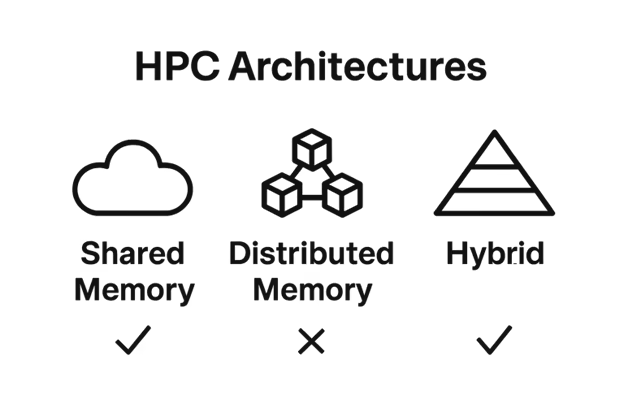
According to research from the National Center for Biotechnology Information, HPC systems employ several architectural models that optimize computational performance:
HPC systems employ advanced algorithms and middleware that intelligently partition complex computational problems into smaller, manageable segments. These segments are then distributed across multiple processing units, enabling simultaneous computation and dramatically reducing overall task completion time. Workload management becomes critical in these environments, requiring sophisticated scheduling mechanisms that dynamically allocate computational resources based on task complexity and system availability.
Designers of HPC systems continuously refine architectural approaches to maximize computational efficiency. Key optimization strategies include:
Learn more about advanced computing infrastructure to understand how these intricate design principles enable breakthrough computational capabilities. The continuous evolution of HPC architectures represents a critical frontier in technological innovation, pushing the boundaries of what is computationally achievable across scientific, industrial, and research domains.
The following table compares major parallel processing architectures used in HPC systems, highlighting their architectural model and defining features.
| Architecture Type | Memory Model | Key Features |
|---|---|---|
| Shared Memory | Shared/global memory | Easy data sharing, fast access, limited scalability |
| Distributed Memory | Dedicated/independent | High scalability, complex communication between nodes |
| Hybrid Memory | Combination | Balances scalability and data access efficiency |
| Clustered Computing | Distributed/shared | Multiple interconnected systems acting as a single resource |
High Performance Computing (HPC) has emerged as a transformative technology that enables unprecedented computational capabilities across diverse industrial and scientific domains. By providing immense processing power and advanced analytical capabilities, HPC systems are revolutionizing how complex problems are solved and innovative solutions are developed.
Computational modeling and simulation represent critical applications of HPC in scientific research. According to research from the National Science Foundation, HPC systems enable researchers to conduct complex experiments and analyze massive datasets that were previously impossible to process. These computational capabilities have profound implications across multiple scientific disciplines:
Engineering disciplines leverage HPC to revolutionize product design, simulation, and optimization processes. Advanced computational techniques allow engineers to create intricate digital models, perform complex stress analyses, and simulate real world performance scenarios with extraordinary precision. Industries such as aerospace, automotive, and manufacturing utilize HPC for:

Financial institutions and investment firms increasingly rely on HPC systems to perform sophisticated risk assessments, develop predictive models, and execute high frequency trading strategies. By processing vast amounts of market data simultaneously, HPC enables more accurate financial predictions and complex algorithmic trading approaches.
Explore advanced computing infrastructure solutions to understand how cutting edge computational technologies are transforming industries. The integration of HPC across diverse sectors demonstrates its potential to drive technological innovation and solve increasingly complex global challenges.
This table categorizes key scientific, engineering, and financial applications of High Performance Computing, providing examples of tasks handled within each domain.
| Application Domain | HPC Use Cases | Examples |
|---|---|---|
| Scientific Research | Modeling, simulation, data analysis | Climate, molecular, astronomy, physics |
| Industrial Engineering | Design simulation, optimization, prototyping | Aerospace, automotive, material research |
| Financial Modeling | Risk assessment, predictive analytics, trading | Algorithmic trading, risk modeling |
The landscape of High Performance Computing (HPC) is rapidly evolving, driven by unprecedented technological innovations and expanding computational demands across global industries. Emerging trends are poised to revolutionize how complex computational challenges are addressed, pushing the boundaries of computational capabilities beyond current technological limitations.
Exascale computing represents a monumental leap in computational power, enabling systems to perform a quintillion calculations per second. According to research from the National Science Foundation, these next generation computing systems will dramatically transform scientific research, artificial intelligence, and complex problem solving across multiple domains:
The convergence of HPC with artificial intelligence and machine learning technologies is creating powerful computational ecosystems. Specialized hardware architectures are being developed to support increasingly sophisticated AI computational requirements, enabling more complex neural network processing and deep learning capabilities. This integration allows for:
Future HPC systems are focusing intensely on energy efficiency and sustainable computing design. Researchers and engineers are developing innovative cooling technologies, advanced power management systems, and computational architectures that minimize energy consumption while maximizing processing capabilities. These developments aim to:
Explore digital transformation strategies to understand how cutting edge computational technologies are reshaping technological landscapes. The future of High Performance Computing promises unprecedented computational capabilities that will continue to push the boundaries of human knowledge and technological innovation.
You have just explored the basics of High Performance Computing and discovered how crucial parallel processing, advanced hardware, and smart system architecture are for tackling real-world scientific and business challenges. But understanding HPC is only the first step. The real challenge is finding trusted, scalable solutions that actually deliver results for your team or organization. Many groups struggle with sourcing reliable GPU servers and scalable infrastructure. Delays, outdated equipment, and a lack of transparency in transactions can easily hold you back from success. If you want to bridge the gap between learning about HPC and actually benefiting from it, you need a solution that brings clarity and speed to procurement.
Now is the time to move from theory to practice. Explore live inventory, secure bulk orders, or sell surplus tech with confidence on Blockware Solutions Marketplace. Get the right enterprise-grade AI and HPC hardware with full support, verified listings, and quick logistics. Do not let outdated infrastructure hold you back. Visit https://nodestream.blockwaresolutions.com today and take your high-performance computing to the next level.
High Performance Computing (HPC) refers to the use of advanced computing systems that perform complex calculations at incredibly high speeds, leveraging multiple processors to handle massive datasets and computational tasks.
HPC works through parallel processing architectures where multiple processors execute computations simultaneously. This approach significantly reduces the time required to solve complex computational problems compared to traditional computing systems.
HPC is widely used in fields such as scientific research, industrial engineering, financial modeling, and data analysis. It’s particularly valuable for tasks like climate modeling, molecular research, and optimizing product designs.
Future trends in HPC include the development of exascale computing capabilities, integration with artificial intelligence and machine learning, and a focus on energy efficiency to make computing systems more sustainable.