
Private cloud often gets labeled as just another fancy IT solution, but its real impact goes far beyond the buzz. Some companies are now keeping 100 percent of their sensitive data in private clouds that never leave their own buildings. Surprisingly, that does not mean every private cloud sits on a server right down the hall. What actually sets private cloud apart is how it blends flexibility and control, changing everything you thought you knew about on-premise tech.
| Takeaway | Explanation |
|---|---|
| Private cloud enhances security and control | Private cloud offers dedicated infrastructure for single organization use, ensuring secure and compliant environments unlike public clouds. |
| On-premise and private cloud are distinct | While on-premise refers to hardware physically located at an organization, private cloud can be both on-premise and off-site, utilizing virtualization. |
| Operational flexibility with customizable resources | Private cloud solutions enable enterprises to dynamically adjust computational resources based on demand, leading to improved efficiency and responsiveness. |
| Compliance tailored to business needs | Organizations can modify their private cloud infrastructures to meet specific regulatory and security requirements, enhancing data protection. |
| Enhanced resource management through virtualization | Virtualization in private clouds allows for effective resource allocation, ensuring operational agility and better hardware utilization. |
Understanding whether a private cloud is on premise requires unpacking the complex landscape of cloud computing infrastructure. At its core, private cloud represents a computing model that provides dedicated infrastructure exclusively for a single organization, offering enhanced security and control compared to public cloud environments.
Private cloud infrastructure distinguishes itself through several key characteristics. According to the General Services Administration’s Cloud Information Center, a private cloud is provisioned for exclusive use by a single consumer. This means the computing resources are not shared with other organizations, creating a more controlled and secure environment.
Key attributes of private cloud infrastructure include:
The relationship between private cloud and on-premise infrastructure is often misunderstood. While they share similarities, they are not identical concepts. On-premise infrastructure traditionally refers to hardware and software physically located within an organization’s own data center. Private cloud, however, can exist both on-premise and off-site, managed by the organization or a third-party provider.
As OpenStax’s Information Systems research explains, the critical difference lies in the computing model. On-premise environments typically involve direct ownership and management of physical hardware, whereas private cloud introduces virtualization and more flexible resource allocation.
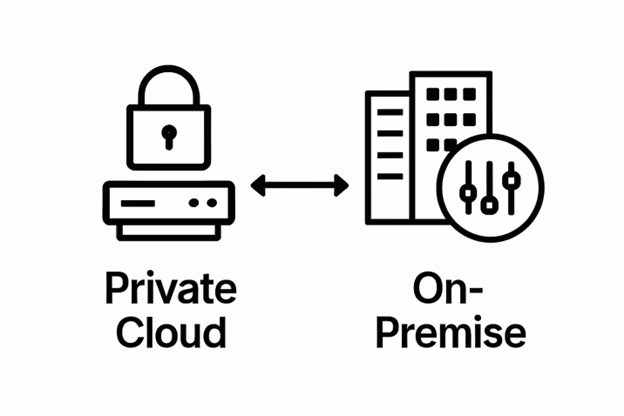
Understanding these distinctions helps organizations make informed decisions about their computing infrastructure, balancing factors like security, scalability, and operational efficiency.
Below is a table that compares core attributes and differences between on-premise infrastructure and private cloud, clarifying their relationship and distinctions for readers.
| Characteristic | On-Premise Infrastructure | Private Cloud Infrastructure |
|---|---|---|
| Location | Physically within organization’s data center | Can be on-premise or off-site |
| Ownership & Management | Owned and managed by the organization | May be managed by organization or a third-party provider |
| Resource Sharing | Dedicated solely for organization’s use | Dedicated to one organization, not shared with others |
| Virtualization | Traditionally less emphasis on virtualization | Strong focus on virtualization and flexible resource allocation |
| Scalability | Limited by physical hardware | More dynamic, allows for rapid scaling of resources |
| Security & Compliance | Directly controlled and enforced by organization | Enhanced controls, often customizable for regulatory needs |
| Customizability | High, but may lack cloud agility | Highly customizable, incorporates cloud management tools |
Private cloud solutions represent a strategic technological approach that enables enterprises to leverage advanced computing infrastructures while maintaining granular control over their digital environments. These solutions provide organizations with unprecedented flexibility in managing computational resources, data security, and operational scalability.
Enterprises require robust security frameworks that protect sensitive information while enabling technological innovation. According to research from the Frontiers in Big Data journal, private cloud solutions allow organizations to tailor their computing environments to meet specific regulatory requirements and data sovereignty needs.
Key security benefits include:
Private cloud solutions transform how enterprises approach computational resource allocation. By providing customizable infrastructure, organizations can dynamically adjust computing capabilities without significant capital investments. This model enables businesses to scale resources precisely according to operational demands, optimizing both technological performance and financial efficiency.
The strategic advantages extend beyond traditional infrastructure models by offering:
By implementing private cloud solutions, enterprises create a robust technological ecosystem that balances security, performance, and operational agility. The ability to maintain direct control over infrastructure while enjoying cloud-like flexibility represents a transformative approach to enterprise computing strategies.
Private cloud within on-premise settings represents a sophisticated technological approach where organizations leverage cloud computing principles directly within their existing physical infrastructure. This model enables businesses to transform traditional data centers into more dynamic, flexible computing environments while maintaining complete control over their technological resources.
According to the National Institute of Standards and Technology, private cloud infrastructure is provisioned exclusively for a single organization, enabling sophisticated resource allocation and management strategies. On-premise private cloud deployments utilize virtualization technologies to create flexible, scalable computing environments within an organization’s existing data center.
Key virtualization characteristics include:
On-premise private cloud environments provide unparalleled security and operational control. Organizations can implement robust access management protocols, encryption strategies, and compliance frameworks directly within their physical infrastructure. This approach ensures that sensitive data remains within the organization’s controlled environment while benefiting from cloud-like operational flexibility.
Critical control mechanisms involve:
By implementing private cloud within on-premise settings, enterprises create a powerful technological ecosystem that balances security, performance, and operational agility. This model represents a strategic approach to digital infrastructure, allowing organizations to maximize their existing technological investments while embracing modern computing paradigms.

On-premise private cloud deployments represent a strategic technological solution that empowers organizations to harness cloud computing capabilities while maintaining complete control over their infrastructure. This approach provides enterprises with a sophisticated method of managing computational resources that balances security, performance, and operational flexibility.
According to UMA Technology, private cloud environments offer unparalleled security capabilities that distinguish them from traditional infrastructure models. Organizations can implement comprehensive security measures tailored precisely to their specific regulatory and operational requirements.
Key security advantages include:
On-premise private cloud deployments enable organizations to transform their existing infrastructure into more dynamic and responsive computing environments. By leveraging virtualization technologies, enterprises can achieve unprecedented levels of resource utilization and computational efficiency.
Strategic operational benefits encompass:
The on-premise private cloud model represents a powerful approach to enterprise computing.
This table summarizes key features of on-premise private cloud deployments, offering a quick reference for the benefits and capabilities described in the article.
| Feature | Description |
|---|---|
| Security & Compliance | Strict data isolation and customizable encryption tailored to requirements |
| Resource Optimization | Improved hardware utilization through virtualization |
| Flexible Scalability | Rapid scaling of resources without major capital investment |
| Operational Control | Granular access management and direct infrastructure oversight |
| Performance Predictability | Consistent, reliable performance metrics |
| Data Sovereignty | All data managed within organization’s own environment |
| Compliance Frameworks | Easily adapted to industry and regional regulations |
On-premise private cloud solutions have emerged as critical technological infrastructure for organizations requiring advanced computational capabilities with stringent security and compliance requirements. These deployments represent strategic approaches to managing complex technological ecosystems across multiple critical industries.
In healthcare environments, on-premise private cloud infrastructures enable organizations to manage sensitive patient data while maintaining strict regulatory compliance. According to IEEE research, medical institutions leverage private cloud technologies to support complex computational workloads such as genomic research, medical imaging processing, and predictive diagnostic analytics.
Key healthcare deployment advantages include:
Financial institutions require robust computing infrastructures that provide exceptional security and real-time processing capabilities. On-premise private cloud solutions offer financial organizations the ability to maintain complete control over critical transactional data and computational resources while implementing sophisticated risk management technologies.
Strategic benefits for financial services encompass:
By implementing on-premise private cloud solutions, organizations across diverse sectors can create powerful technological ecosystems that balance security, performance, and operational flexibility. These deployments represent a sophisticated approach to managing computational resources while maintaining granular control over critical infrastructure.
Choosing the right private cloud environment for your organization is no small task. If you are struggling to balance strict security needs, compliance requirements, and the operational flexibility described in this article, you are not alone. Many enterprises like yours find the journey to efficient, on-premise private cloud complicated by a lack of verified infrastructure, inefficiencies in procurement, or uncertainty about how to scale high-performance resources for AI and data-intensive tasks. That is where tailored, enterprise-ready HPC and AI solutions become essential for true peace of mind.
Experience greater control and confidence in your infrastructure. Browse https://nodestream.blockwaresolutions.com today for instant access to real-time inventory, bulk ordering, and customized deployments built for secure, on-premise private clouds. Leverage a trusted marketplace to buy, sell, or scale your private cloud and HPC assets with full transparency and expert support services. Make the move now to safeguard your mission-critical workloads and streamline your journey from discovery to deployment. Start optimizing your private infrastructure right here with Nodestream’s transparent platform.
Private cloud infrastructure is a dedicated computing model exclusively for one organization, while on-premise infrastructure refers to hardware and software physically located within the organization’s data center. Private cloud can also be hosted off-site and managed by a third party.
Yes, a private cloud can be hosted on-premise. This setup allows organizations to use cloud computing principles within their existing physical infrastructure while maintaining control over their resources.
Private cloud solutions provide enhanced security through dedicated infrastructure, controlled access, customizable encryption protocols, and comprehensive compliance with industry regulations, minimizing the risk of unauthorized data exposure.
Virtualization allows for the abstraction of computing resources from physical hardware, enabling dynamic allocation, improved hardware utilization, and greater control over resource distribution in an on-premise private cloud environment.