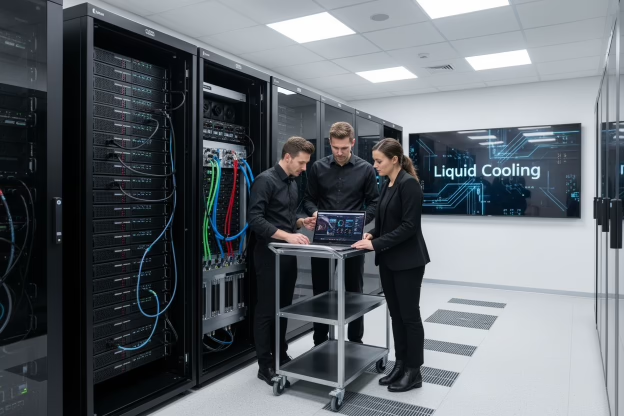
Servers are getting more powerful every year, and their energy use is skyrocketing. Some high-performance computing systems now use so much power that traditional air cooling struggles to keep up and can lead to performance drops of up to 30 percent due to overheating. Most people think the only answer is to add more fans or bigger air conditioners. The real breakthrough is happening inside the server racks, where liquid cooling is quietly changing the rules by pulling heat away faster and helping machines run stronger and longer.
| Takeaway | Explanation |
|---|---|
| Liquid cooling enhances thermal management efficiency. | It directly absorbs heat from server components, improving performance and reliability compared to air cooling. |
| Reduces energy consumption by up to 40%. | Efficient liquid cooling technologies lower energy needs, resulting in cost savings and a reduced carbon footprint for data centers. |
| Maintains optimal performance under heavy loads. | Liquid cooling prevents thermal throttling, allowing servers to operate at peak efficiency, even during demanding computational tasks. |
| Essential for hyperscale data centers. | As computation density increases, traditional cooling methods become inadequate, making liquid cooling crucial for managing heat in large cloud infrastructures. |
| Prolongs hardware lifespan and reliability. | Improved temperature control helps to reduce wear and failures in critical components, leading to longer-lasting server infrastructure. |
Liquid cooling represents an advanced thermal management strategy for high-performance computing environments, transforming how server infrastructure manages heat generation. Unlike traditional air cooling methods, liquid cooling uses specialized fluids to directly absorb and transfer heat from critical server components, enabling more efficient and reliable temperature regulation.
At its core, liquid cooling operates on a fundamental principle of heat transfer. By circulating liquid directly near or through server components like CPUs, GPUs, and memory modules, the cooling medium can absorb thermal energy more effectively than air. According to Intel, this method allows for significantly improved heat dissipation compared to traditional air cooling techniques.
The liquid cooling process typically involves several key components:
Liquid cooling becomes particularly crucial in modern server environments characterized by intense computational workloads. Data Center Knowledge highlights that dense compute environments like AI training clusters, machine learning infrastructure, and high-performance computing centers generate substantial heat, making liquid cooling not just advantageous but often necessary.
By enabling more precise and efficient thermal management, liquid cooling allows servers to maintain optimal performance levels, reduce thermal throttling, and extend the operational lifespan of expensive computing hardware. This technology represents a critical evolution in server design, addressing the escalating thermal challenges posed by increasingly powerful and compact computing systems.
Below is a comparison table outlining the main differences between traditional air cooling and liquid cooling approaches for servers, as referenced throughout the article.
| Aspect | Air Cooling | Liquid Cooling |
|---|---|---|
| Heat Transfer Method | Uses fans and airflow to dissipate heat | Circulates specialized liquid for direct heat absorption |
| Cooling Efficiency | Lower, may struggle with high-density servers | Higher, efficiently manages heat in dense compute environments |
| Impact on Performance | Risk of thermal throttling, potential 30% performance drop | Maintains optimal performance, prevents thermal throttling |
| Energy Consumption | Higher due to large fans and air conditioning | Can reduce cooling energy use by up to 40% |
| Hardware Longevity | Greater wear from fluctuating temperatures | Enhanced component reliability and longer lifespan |
| Suitability | Standard data centers or lower-density servers | Essential for high-performance, hyperscale, and AI workloads |
Liquid cooling has emerged as a critical technology for addressing the escalating thermal challenges in high-performance computing environments. As computational workloads become increasingly complex and hardware components grow more powerful, traditional cooling methods struggle to maintain optimal performance and system reliability.
Heat represents a fundamental limitation in modern computing infrastructure. When server components generate excessive thermal energy, performance degradation becomes inevitable. According to research from Oak Ridge National Laboratory, temperature increases can cause significant reductions in computational efficiency, with some systems experiencing performance drops of up to 30% when thermal throttling occurs.
Key performance implications of unmanaged heat include:
Beyond performance metrics, liquid cooling offers substantial economic benefits for high-performance computing environments. By enabling more efficient thermal management, organizations can achieve significant infrastructure optimizations. Learn more about HPC infrastructure strategies to understand the broader context of computational efficiency.
Liquid cooling dramatically reduces energy consumption associated with traditional air cooling systems.
Advanced liquid cooling techniques can lower cooling energy requirements by up to 40%, translating into substantial cost savings and reduced carbon footprint for data centers and enterprise computing environments.
The strategic implementation of liquid cooling represents more than a technological upgrade it is a fundamental reimagining of how computational infrastructure manages thermal dynamics, positioning organizations to handle increasingly demanding computational workloads with greater reliability and efficiency.
Liquid cooling represents a sophisticated thermal management approach that transforms how heat is extracted from high-performance computing systems. By leveraging the superior thermal transfer capabilities of specialized fluids, this technology provides a more efficient alternative to traditional air cooling methods.
According to the U.S. Department of Energy, liquid cooling operates on fundamental principles of thermodynamics and heat transfer. The process begins with direct contact between a cold plate and heat-generating components like CPUs and GPUs. These specialized metal surfaces absorb thermal energy from electronic components, transferring it immediately to the circulating liquid.
Key components in the liquid cooling mechanism include:
Liquid cooling technologies have evolved to accommodate diverse server architectures. Two primary approaches dominate the landscape: direct-to-chip cooling and full immersion cooling. Learn more about HPC infrastructure strategies to understand the nuanced implementation of these cooling techniques.
Direct-to-chip cooling involves precisely engineered cold plates attached directly to heat sources, allowing for targeted and efficient thermal management. In contrast, full immersion cooling submerges entire server components in specialized dielectric fluids, enabling comprehensive and uniform heat absorption.
The precision of liquid cooling allows for significantly more controlled thermal environments compared to traditional air cooling, enabling computing systems to maintain optimal performance levels while extending hardware longevity and reliability.
Here is a feature table summarizing the key components found in a typical liquid cooling system for servers, along with their primary function, as described in the article.
| Component | Description | Main Function |
|---|---|---|
| Cold Plate | Metal surface attached to heat sources | Absorbs heat from server components |
| Pump | Circulates coolant through system | Moves liquid to ensure efficient heat transfer |
| Heat Exchanger | Transfers heat from liquid to outside | Removes heat from cooling circuit |
| Radiator | Fin structure for passive/active cooling | Dissipates excess heat into environment |
| Specialized Coolant | Engineered liquid with high conductivity | Efficiently absorbs and carries away heat |
| Tubing/Manifold | Connects all components and pathways | Routes coolant between system elements |
Liquid cooling systems represent a complex ecosystem of thermal management technologies designed to address the intricate heat dissipation challenges in advanced computing environments. Understanding these systems requires a comprehensive examination of their core architectural principles and operational dynamics.
According to research from Lawrence Berkeley National Laboratory, thermal transfer in liquid cooling systems relies on sophisticated interactions between specialized materials and engineered fluid dynamics. The core principle involves creating an efficient pathway for heat energy to move from high-temperature electronic components to cooling media with superior thermal conductivity.
Critical thermal transfer characteristics include:
Liquid cooling system design encompasses multiple interdependent components that work synergistically to manage thermal energy. Explore advanced HPC infrastructure strategies to understand the broader context of computational thermal management.
The architectural complexity of liquid cooling systems demands precise engineering across several critical domains. Designers must carefully balance factors such as fluid selection, circulation mechanisms, heat exchanger efficiency, and materials compatibility. Advanced systems incorporate intelligent monitoring technologies that provide real-time thermal performance metrics, enabling dynamic adjustments to cooling strategies.
By integrating sophisticated thermal management principles, liquid cooling systems transform heat from a potential performance limitation into a manageable and predictable engineering parameter, ultimately supporting the relentless advancement of high-performance computing infrastructure.
Liquid cooling technologies have transitioned from experimental concepts to mission-critical infrastructure solutions across multiple high-performance computing environments. As computational demands escalate, organizations are increasingly adopting sophisticated liquid cooling strategies to maintain operational efficiency and technological competitiveness.
According to research from Microsoft Azure, liquid cooling has become essential in managing thermal dynamics for massive cloud computing infrastructure. Hyperscale data centers require unprecedented computational density, generating immense heat that traditional air cooling methods cannot effectively manage.
Key deployment scenarios include:
Liquid cooling technologies have revolutionized thermal management strategies across diverse computational domains. Learn more about HPC infrastructure strategies to understand the comprehensive impact of advanced cooling technologies.
Research laboratories, financial institutions, and advanced technological enterprises are rapidly adopting liquid cooling to support increasingly complex computational requirements. By enabling more precise thermal control, these organizations can maintain higher computational densities, reduce energy consumption, and extend hardware lifecycle substantially.
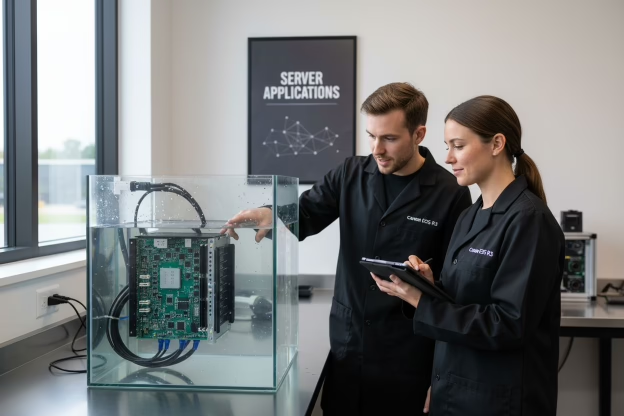
The strategic implementation of liquid cooling represents a fundamental transformation in how computational infrastructure manages thermal dynamics, positioning organizations to handle increasingly demanding workloads with unprecedented reliability and efficiency.
Navigating the complexities of liquid cooling for high-performance servers is not just about knowledge it is about execution and results. If you are struggling with excessive heat, inefficient cooling, or rising energy costs as described in the article, you already know how critical reliable thermal management is for maintaining AI, machine learning, or data-intensive workloads. Key pain points like hardware slowdowns, performance limitations, and system reliability stem from thermal issues that demand a cutting-edge infrastructure solution.
Your next move matters. Experience real-time access to verified GPU and HPC equipment, rapid deployment, and comprehensive support services with Nodestream by Blockware Solutions . Do not let outdated cooling or procurement bottlenecks hold your operations back. Explore how our platform streamlines infrastructure scaling and matches you with tailored, liquid cooling–ready servers for your most demanding workloads. Visit our platform now and see how transparent, efficient HPC transactions can empower your team.
Liquid cooling for servers is an advanced thermal management method that uses specialized liquids to absorb and transfer heat away from critical server components, ensuring more efficient temperature regulation compared to traditional air cooling.
Liquid cooling enables better thermal management, maintaining optimal performance levels, reducing the risk of thermal throttling, and extending the lifespan of components, which is crucial for high-demand computational tasks like AI training and scientific research.
Key components of a liquid cooling system include cold plates that attach to heat-generating components, pumps to circulate the coolant, heat exchangers to dissipate absorbed heat, and specialized coolants optimized for thermal transfer.
Liquid cooling can significantly reduce energy consumption related to cooling, lowering cooling energy requirements by up to 40%. This leads to substantial cost savings and a reduced carbon footprint for data centers and enterprises.