
Server CPUs and desktop CPUs might look similar, but their roles in the world of computing could not be more different. Get a load of this. Some server CPUs support hundreds of gigabytes or even terabytes of RAM compared to the usual 64 to 128 gigabytes on desktops. And while most people chase after the fastest clock speed, the real secret is that server CPUs are built for nonstop action and never missing a beat—even if it means sacrificing a little speed for rock-solid reliability. That flips the script on what power really means inside a processor.
| Takeaway | Explanation |
|---|---|
| Server CPUs ensure reliability for critical tasks | Engineered for sustained operations, they excel in complex, high-demand environments like data centers and cloud computing. |
| Desktop CPUs prioritize single-thread performance | Designed for individual user experiences, they offer high speeds ideal for gaming, content creation, and other personal tasks. |
| Evaluate workload needs before CPU selection | Assess factors like processing intensity and data integrity to determine if a server or desktop CPU is more suitable. |
| Consider long-term scalability and costs | Server CPUs are more expensive but offer advanced capabilities and longer lifespans, making them a strategic investment. |
| Memory management differentiates processors | Server CPUs support larger memory and ECC, ensuring data integrity in high-stakes environments; desktops focus on user-level needs. |
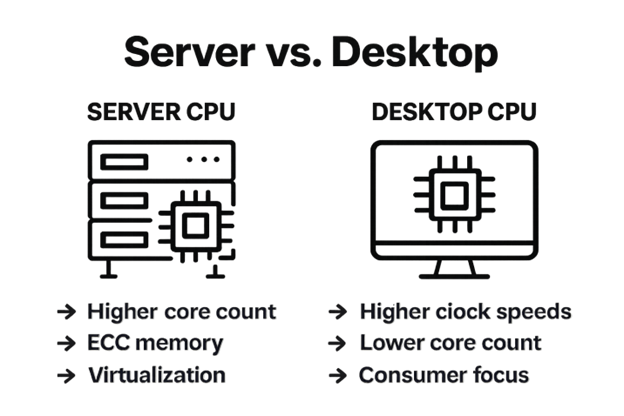
Server CPUs and desktop CPUs represent two distinct processor categories designed for fundamentally different computing environments and workloads. While they might appear similar at first glance, these processors have critical architectural differences that make them specialized for their respective use cases.
Server CPUs are engineered for continuous operation, complex multitasking, and enterprise-grade reliability. Unlike desktop processors, they incorporate advanced features like Error Correction Code (ECC) memory support, which helps detect and automatically correct memory data corruption. These processors prioritize stability and consistent performance over raw speed, making them ideal for mission-critical applications in data centers, cloud computing infrastructure, and complex computational environments.
Desktop CPUs, conversely, are optimized for individual user experiences. They focus on delivering high single-thread performance, enabling smooth gaming, content creation, and personal computing tasks. These processors typically have lower core counts compared to server CPUs but provide higher clock speeds and more aggressive boost mechanisms to enhance user-facing application responsiveness.
The performance profiles of server CPUs and desktop CPUs diverge significantly. Intel provides insights showing that server processors are designed to handle:
These specialized characteristics ensure server CPUs can manage complex, continuous computational tasks across enterprise, scientific research, and cloud computing environments. Desktop CPUs, while powerful, are not built to sustain the same level of consistent, high-intensity workloads that server processors handle with ease.
Understanding these fundamental differences helps organizations and professionals select the most appropriate processing technology for their specific computational requirements, ensuring optimal performance, reliability, and efficiency.
The following table clearly compares key architectural and performance features of server CPUs and desktop CPUs, helping readers quickly see how each type is optimized for its typical use case.
| Feature / Characteristic | Server CPUs | Desktop CPUs |
|---|---|---|
| Primary Design Goal | Reliability, continuous workload, multitasking | High single-thread speed, user responsiveness |
| Core Count | High (many cores for parallel processing) | Lower (focus on fast individual cores) |
| Clock Speed | Lower, steady | Higher, with aggressive boost |
| Supported Memory | Hundreds of GB to terabytes; ECC support | 64-128 GB typical; ECC rarely supported |
| Error Correction (ECC) | Yes, standard for data integrity | Rare |
| Virtualization/Security | Advanced features | Basic to moderate |
| Typical Use Cases | Data centers, cloud computing, scientific research | Gaming, content creation, office/professional tasks |
The architectural and performance distinctions between server CPUs and desktop CPUs extend far beyond surface-level specifications, representing fundamental design philosophies tailored to specific computational requirements. These differences manifest in multiple critical domains that directly impact system capability, reliability, and overall computational efficiency.
Server CPUs are meticulously engineered to handle complex, sustained computational workloads with exceptional reliability. Their architecture prioritizes parallel processing capabilities, enabling simultaneous execution of multiple tasks across numerous cores. This design allows server processors to manage intricate computational demands typical in enterprise environments such as database management, cloud computing, and scientific research.
In contrast, desktop CPUs are optimized for single-threaded performance, focusing on delivering responsive user experiences. They excel in scenarios requiring rapid, intermittent processing like gaming, graphic design, and personal productivity applications. The architectural emphasis shifts from sustained parallel performance to quick, efficient single-task execution.
Research from Iowa State University highlights critical memory management differences between server and desktop processors. Server CPUs typically support:
These memory management features ensure data integrity, reduce computational errors, and provide robust performance in mission-critical environments where even minor data corruption can have significant consequences.
Desktop processors, while advanced, have memory architectures designed for personal computing paradigms. They offer sufficient memory capacity and speed for typical user workflows but lack the extensive error correction and large-scale memory management capabilities inherent in server CPUs.
Understanding these architectural nuances enables organizations to make informed decisions about processor selection, ensuring optimal computational resources aligned with specific technological requirements and performance expectations.
High-Performance Computing (HPC) represents a critical technological frontier where server CPUs play an absolutely pivotal role in solving complex computational challenges across multiple industries. These specialized processors are not merely components but fundamental enablers of breakthrough scientific, research, and enterprise-level computational capabilities.
Server CPUs are uniquely designed to handle massive computational workloads through advanced parallel processing architectures. Unlike desktop processors, they can efficiently distribute complex computational tasks across multiple cores and processors, enabling simultaneous execution of intricate algorithms. This architectural approach allows researchers and organizations to tackle problems that would be impossible with traditional computing methods.
Research from the U.S. Geological Survey reveals that HPC environments leverage server CPUs to aggregate massive computing power, solving large-scale problems in scientific research, engineering, and complex business analytics. The ability to process enormous datasets and execute sophisticated computational models represents a quantum leap in technological capability.
Server CPUs drive innovation across numerous high-stakes domains by providing unprecedented computational capabilities. These processors support critical applications in:
The computational complexity these environments demand requires processors that can sustain intense workloads with extraordinary reliability and precision. Learn more about HPC infrastructure for enterprises, where server CPUs transform theoretical possibilities into tangible technological achievements.
Ultimately, server CPUs represent more than technological components. They are the fundamental engines driving humanity’s most advanced computational frontiers, enabling breakthrough discoveries and pushing the boundaries of what computational science can achieve.

The practical deployment of server and desktop CPUs reveals a nuanced landscape of computational specialization, where each processor type demonstrates remarkable capabilities tailored to specific operational environments. Understanding these real-world applications illuminates the critical design considerations that distinguish these processor categories.
Server CPUs excel in complex, sustained computational environments where reliability, data integrity, and continuous performance are paramount. Financial institutions leverage these processors for high-frequency trading algorithms, processing millions of transactions with microsecond precision. Scientific research laboratories utilize server CPUs in genomic sequencing, climate modeling, and particle physics simulations, where computational accuracy and parallel processing capabilities are mission-critical.
Research from the National Institutes of Health demonstrates that bioinformatics research specifically relies on server CPU architectures to manage extensive data analysis pipelines, enabling researchers to process vast genomic datasets with unprecedented efficiency and reliability.
Desktop CPUs dominate scenarios requiring responsive, individual user experiences. These processors shine in:
The single-thread performance of desktop CPUs ensures smooth, responsive interactions across personal and professional creative workflows. Learn more about AI computing infrastructure that bridges these computational paradigms.
Understanding the distinct capabilities of server and desktop CPUs empowers organizations and individuals to select the most appropriate computational resources, optimizing performance, efficiency, and technological investment across diverse computing landscapes.
The following table highlights example real-world applications for both server CPUs and desktop CPUs, clarifying which processor excels in which computing scenarios.
| Environment / Application | Server CPUs (Best Fit) | Desktop CPUs (Best Fit) |
|---|---|---|
| Financial Trading | High-frequency trading, transaction processing | Financial modeling, portfolio tracking |
| Scientific Research | Genomic sequencing, climate modeling, physics sims | Data analysis, graphing, report generation |
| Creative Work | Large-scale 3D rendering farms | Video editing, graphic design, music prod. |
| AI & Machine Learning | Model training, inference at scale | Prototyping, basic model training |
| Business Operations | Web servers, ERP systems, database hosting | Office applications, presentations |
| Gaming | Not typical | Gaming (single or multi-player) |
Selecting the appropriate CPU requires a strategic approach that balances computational requirements, budget constraints, and specific performance expectations. Understanding the nuanced differences between server and desktop processors enables organizations and individuals to make informed technological investments.
Computational workload analysis represents the foundational step in CPU selection. Organizations must critically evaluate their specific processing demands, considering factors such as:
Server CPUs become optimal when workloads demand continuous, high-reliability performance across complex computational environments. These processors excel in scenarios requiring advanced error correction, massive parallel processing, and extended operational lifespans.
Research from Iowa State University highlights that CPU selection involves intricate trade-offs between initial investment and long-term computational efficiency. Desktop CPUs offer lower upfront costs and higher single-thread performance, making them attractive for individual users and small-scale professional applications.
Server processors, while more expensive, provide:
The decision ultimately hinges on matching processor capabilities with specific computational requirements, ensuring optimal performance without unnecessary financial overhead.
Ultimately, the right CPU transforms from a mere hardware component to a strategic computational asset, bridging technological potential with practical operational needs.
Understanding the difference between server CPUs and desktop CPUs is crucial when your organization faces the challenge of matching hardware with demanding workloads. The article highlights how server CPUs deliver reliability, scale, and advanced processing power while desktop CPUs focus on single-thread performance. If you are struggling to manage vast data, power complex AI models, or handle sustained parallel workloads, you already know the risks of making the wrong infrastructure choice. Unplanned downtime, processing bottlenecks, or tech mismatches can stall your growth and put vital projects at risk.
Now is your chance to turn knowledge into a competitive edge. Nodestream by Blockware Solutions bridges the gap between education and execution. Explore a marketplace built for enterprises and research teams demanding real-time HPC and AI-ready infrastructure. Tap into bulk orders, verified servers with true enterprise-grade support, and global access to specialized compute assets. Do not let hardware confusion or limited inventory hold you back. Visit our platform today and unlock smarter hardware for your next breakthrough. Find your perfect high-performance solution now.
Server CPUs are designed for continuous operation and complex multitasking, focusing on reliability and stability. They support advanced features like ECC memory and handle massive parallel processing. Desktop CPUs, on the other hand, are optimized for single-thread performance, focusing on speed for tasks like gaming and content creation.
Server CPUs are generally more costly due to their advanced functionalities, such as larger memory configurations, enhanced security features, and superior multi-core performance. They are built to handle intensive, continuous workloads in enterprise environments, which require additional reliability and complexity.
Choose a server CPU when your workloads demand high reliability, significant parallel processing capabilities, and long-term continuous performance, such as in data centers, cloud computing, or scientific research. Desktop CPUs are better suited for personal computing or applications requiring quick responses, like gaming and professional creative work.
Server CPUs are used in various applications such as climate modeling, genomic research, artificial intelligence, financial analytics, and complex simulations. They excel in scenarios that require extensive computational power and data integrity, making them vital for research and enterprise solutions.